
Continuum of Care: What does that even mean?
This winter, you may have heard a lot about the “Continuum of Care.”
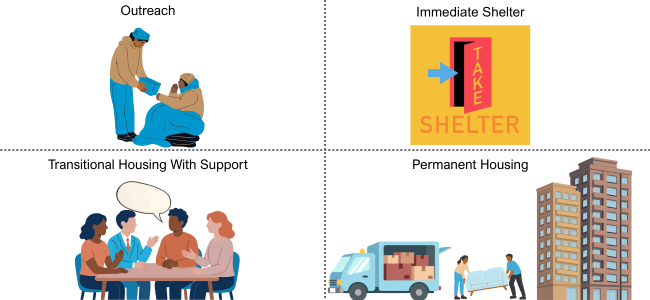
A Continuum of Care is a way of understanding services for homeless individuals as a connected system.
When defining what a Continuum of Care does, the National Alliance to End Homelessness breaks it down best, to paraphrase:
- Outreach and intake: People without housing are engaged actively to reduce the number of people living on the streets or in unsafe temporary shelters.
- Emergency shelters: Immediately give people a place to stay and sleep safely.
- Transitional housing: Temporary housing with supportive services for people who need to build skills or stabilize a health condition before they move to permanent housing.
- Permanent housing and permanent supportive housing: A long-term home. For permanent supportive housing, staff remain closely connected to provide resources and help tenants with a high risk of re-entering shelter.
In the 1990s, the Federal government, via HUD, asked states to streamline their requests for funding homeless services and submit one application for all related services. The states would then distribute money to different agencies and nonprofits that provide services throughout all four stages of the Continuum of Care.
Is a Continuum of Care one system or many?
The Continuum of Care refers to the same concept, but you will hear about multiple “Continuums of Care” when folks are referring to different geographic regions. For example, New York has many regional coalitions that operate on a Continuum of Care model and are sometimes referred to as Continuums of Care.
Why am I hearing so much about the Continuum of Care (or CoC) lately?
In late 2025, the Federal government rescinded the existing funding rules for providing states with money for homeless services via the CoC.
HUD issued new funding rules in November 2025. Nonprofit organizations were seriously concerned with the new funding protocols because:
- They had been issued so late in the year that they risked disrupting many service providers’ work
- The new rules and regulations to get funding were significantly different. The Public Rights Project described that the new HUD funding rule: “Cuts funding for permanent supportive housing by roughly two-thirds… [and] shifts funds toward short-term, punitive models and encourages criminalization of homelessness.”
What is happening with Continuum of Care funding now?
Many states, via their Attorneys General, including Leticia James in New York, filed a lawsuit against HUD. In late December, a judge in Rhode Island said that HUD needed to reinstate the previous funding requirements, not the new ones they issued in November 2025 [Read more].
But there remains uncertainty as litigation continues. Pascale Leone, Executive Director of the Supportive Housing Network of New York, recently described the problem in an interview on WBAI this way: “At the Federal level, we’re seeing a housing agency signal that it is willing to walk away from the only thing that is proven to end homelessness—and that’s housing….” While litigation is pending, Leone continues, “That puts 14,000 affordable homes at risk, more than half of them here in New York City.”
We’ll be watching the evolving story of funding for the Continuum of Care very closely.