
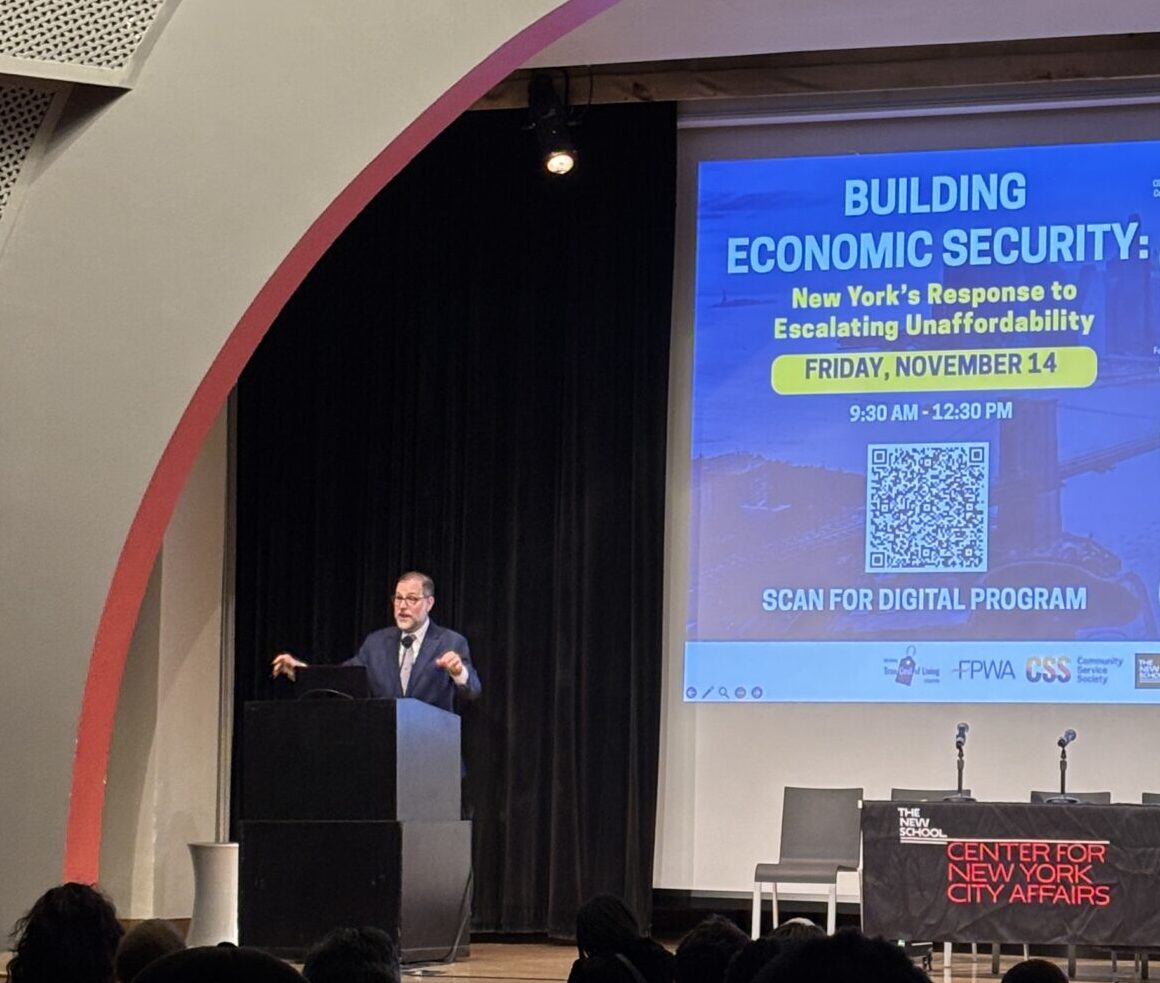
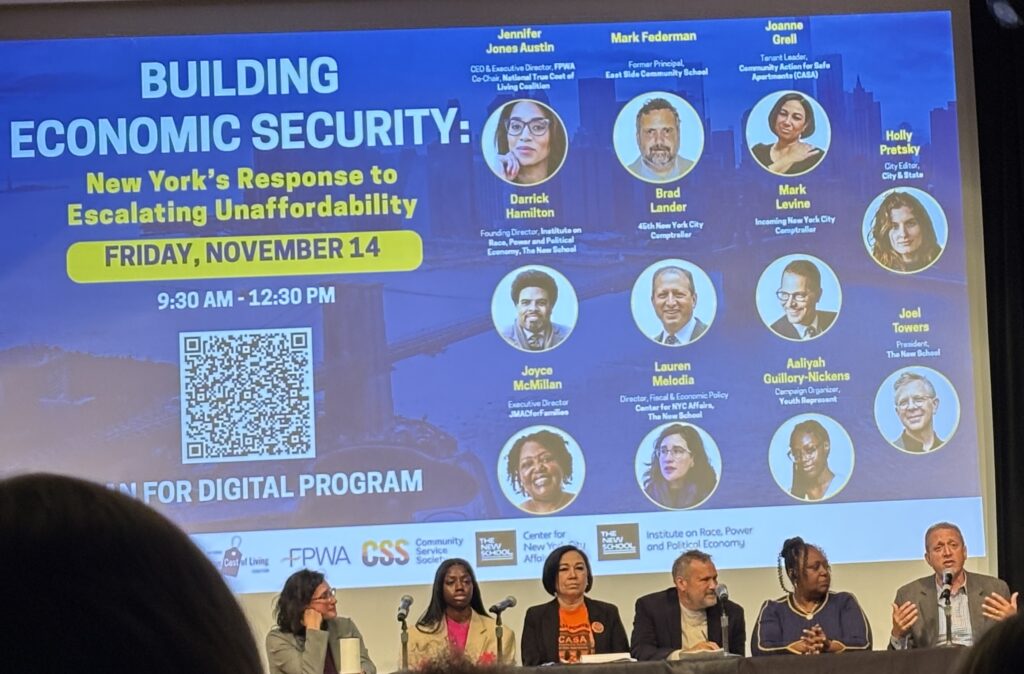
Recently, HousingPlus joined nonprofits from across the city for a special event at The New School titled Building Economic Security: New York’s Response to Escalating Affordability. For us, an organization supporting and implementing Housing First, this was an incredibly impactful half-day discussion, featuring panels and conversations about how we can rethink our view of what causes poverty and the people experiencing it.
This half-day of thoughtful presentations was hosted by the National True Cost of Living Coalition, the Center for New York City Affairs, and the Institute on Race, Power, and Political Economy at The New School. Presenters included Jennifer Jones Austin, CEO of FPWA; Brad Lander, New York City Comptroller; Aaliyah Guillory-Nickens of Youth Represent; and many other leaders.
Here are our top three takeaways and themes from the event, with a focus, as always, on their implications for housing.
1. Drained pool politics can teach us about how emotions and bias impact our policies.
Drained pool politics refers to some cities and towns where, after pools were racially integrated, the local leaders drained the pools rather than oversee a racially integrated space. The result, of course, is that no one, regardless of race, had access to a swimming space. Clearly, this action deprives the entire community of resources. People’s emotions and biases have made them angry enough to take an action that makes no sense for anyone.
It’s important for us at HousingPlus to consider how people’s emotions and biases impact the way they see people who are experiencing homelessness. Witnessing homelessness can bring up a lot of emotions: in cases where the homeless person is not mentally well, it can raise fear; at other times, it can make us depressed to see someone without their basic needs being met. Both emotions make it hard to look at and truly see the individual. Often, the community looks away.
How can we acknowledge and admit to our emotions while actively working against the instinct to embrace hurtful rather than helpful policies?
2. We can flip the traditional thinking about poverty on its head and have a growth and success mindset.
In a conversation between Jennifer Jones Austin and Darrick Hamilton of The New School, Austin said, “We talk of poor people like they were something and someone to manage. Flip that equation around.”
The question we should always be asking ourselves is not “who is poor,” or even “how did they become poor?” The more effective question is: What systems and processes led to or exacerbated this person’s poverty?
Austin and Hamilton went on to discuss the importance of approaching policies that alleviate poverty with a growth and success-oriented mindset. They mentioned that simple steps, for example, making it easy and accessible to have a bank account, can provide less advantaged individuals with a long-lasting and beneficial resource.
HousingPlus agrees: Poor people are not a problem to be solved, but the systems and policies that allow for poverty to grow are indeed the problem. The question we should always be asking ourselves is not “who is poor,” or even “how did they become poor?” The more effective question is: What systems and processes led to or exacerbated this person’s poverty?
3. The true cost of living is designed to shift our mindset from “providing enough to get by” to “providing enough to thrive.”
The reality of the cost of living for every American is that there are the basic needs (food, clothing, shelter). Then there are the needs that, if left unmet, can lead to increased financial burdens and eventually, falling into poverty. These needs include things like health coverage, which, if unavailable in the first place due to cost or circumstances, is likely to result in larger costs down the line when illness occurs. It also includes childcare: a lack of childcare deprives parents of income from employment.
We believe we must look at the true cost of living to understand how to best prevent people from becoming poor and losing essential things like housing. When someone lacks health coverage, childcare, or a savings account, even a small event or emergency could put them one step closer to being unable to pay their rent.
We are so thankful that we were able to absorb such thoughtful information at the Building Economic Security event, and we hope our three takeaways have given you something to think about, too!